reabc/Black Panthers For Beginners/Black Panthers For Beginners.pdf
Web PDF • Imposed PDF• Raw TXT (OCR)


![Inspired by Malcohm’s legacy and funded by the sales of Mao’s Red Book, the Fanthers expanded their activist agenda and stepped up their plan to defend the community. “We’ll protect a mother, protect a broth- er, and protect the community from racist cops..” Seale proclaimed in his autobiography Seize the Time. “And in turn we get brothers in the organization and they will in turn relate to the Red Book. They will relate to political, economic, and social equality in defense of the community." The activity that really put the Panthers on the map was “policing the police.” there were. only 19 Placks out of GO0 officers on the Oakland police force, so the fanthers, 10 say the least, had their hands full. They were so balsy that. they actually followed the Oakland police around, Whenever they encountered the yolice harassing or arresting somebody, Hewton, Seale, and Lil By, Hubton wowta furglfeon] A their car and approach the offi-](Black Panthers For Beginners 14.png)
![ighabazz airlved for thememorfaizafie washoscorted by the members’ of the i Panther groups and everything went off with out a hitch untll Newton discovered that ‘the Panthers from Northern Callfornia were carrylng unloaded weapons. Protecting Malcolm’s widow ~ with unloaded weapone—they may as well have been using water plstols| Newton was furious. He told the Northerners they had three cholcee: Joln Newton’s Panthers, change thelr name, or disband. They found none of the options o their liking. Newton and his Panthers made it plain that they were not Jiving. The group changed its name. By the spring of 1967, the Panther party had increased its numbers, pub- lished its first. mimeographed newsletter, and gained wider recog- nition for ite brazen contempt for the police, who by now were always referred to as the "pigs." IWHY WAS DENLIL ‘DOWELL K|L|_ED T [Brge et [P )21 G](Black Panthers For Beginners 23.png)
![The first rallies and marches vere held at. the courthouse with brothers and sisters chanting: “Free Huey. Free Huey, Free Huey, or the sky’s the limit! Soon it was a kind of shared mantra that. reverberated beyond the radical community, unit ing folks around the world who were ested in social and poiical freedom. HAPPY BIRTHDAY “In February we host the grand birthday party (Mewton was born February 17, 1942] attended by H. Rap Brown and Stokely Carmichael” Hiliard con- tinued. “Huey and the Black Panther Party are becoming known nation- wide. Every day people call headquarters want- ing to give money, start chapters. The second life “of the Party has bequn.” Fund Raising HUEY Birthday Benefit for | | | | | N ‘\ HUEY P. i NEWTON I | | | | | Sonday, Feb. 16, Berheley Dbfimmy Thealn oo 1 .00 Wi i P e oy s g e v hss N](Black Panthers For Beginners 35.png)
![Indceid. the moncy flowed in from all over Lie place as the Fanthers spon sorcd lorums, workshops, and rallics on campuses, at churches and conr iunity organizations. Contributions came in from concerned individuals and support. groups, including lorerunncrs of Lhe White Panthers, Grey antiirs, and Uhe Young Lords. There was even a delegation calling thepn- Honkies for Huey. I Newton was to have the proper representation during the upcoming trial, then buckets of donations were needed, the Panthers preached, selves A decisive coalition was formed between the Fanthers and the Feace and mostly white independent political party—and fron| this alliance additional money was raised in order Lo secure the services| of attorney Charles Garry. Still another alliance was forged between the| Vanthers and leaders of the Student Nonviolent. Coordinating Commit.e] (SNCC). Morc than $10,000 was raised at. a rally in Oakland tha January (caturing Carniichacl, James Forman, and . Rap Brown. T money lasted longer than the aliance, i g Ficedom Par](Black Panthers For Beginners 36.png)

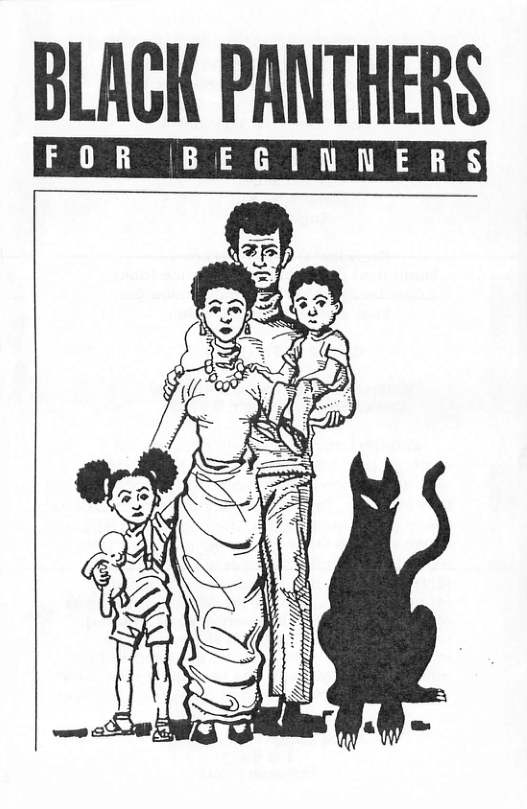
BLAGK PANTHERS
FOR BEGINNERS
This compelling and beaufifully illustrated
book was first published in 1995 by
Writers and Readers Publishers, Inc.
P.O. Box 461, Village Station
New York, New York 10014
Writers and Readers Limited
Cynthia Street
London N1 9JF
England
Copyright @ 1995 Herb Boyd
iiiustrations Copyrighi @ 1995 Lance Tooks
Cover Design @ 1995 Terrie Dunkelberger
Book Design by Paul Gordon
ISBN# 0-86316-196-0
Writers and Readers Documentary
Comlc Book Copyrlght @ 1995
Normally | do not deal with copyrighted
material, but | felt this was a most worthy and
well-done history, which many can benefit from
learning from. They were gracious enough 1o allow
me to add it to the South Chicago ABC Zine Distro.
We offer the finest in revolutionary zines, falling
within the general categories of (1) anarchisr
(2) feminism (3) an! /abolitionism and
(4) prisoner zines. We are ihe Midwest distributors
of all PPWC (Political Prisoners of War Coalition)
publications, including the PPWC Update and
In the Trenches... zine. We also coordinate PPWC
activifies in the Midwest. All zines free to prisoners*
Write for a complefe fisting of publications offered
So. Cmca%: ABC Zine Distro
PO Box 721
Homewood, IL 60430
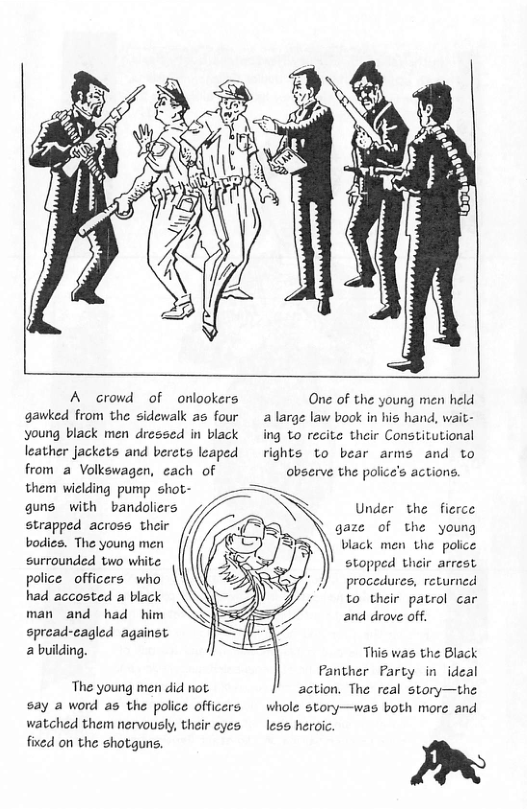
A crowd of
gawked from the sidewalk as four
young black men dressed in black
leather jackets and berets leaped
from a Volkswagen, cach of
them wielding pump shot-
onlookers
gquns with bandolicrs
strapped across their
bodics. The young men
surrounded two white
police officers who
had accosted a black
man and had him
spread-cagled against
2 building.
The young men did not.
say a word as the police officers
watched them nervously, their cycs.
fixed on the shotguns.
One of the young men held
alarge law book in his hand, wait-
ing to recite their Constitutional
rights to bear arms and to
observe the police's actions.
Under the fierce
gaze of the young
black men the police
stopped their arrest
procedures, returned
to their patrol car
and drove off,
This was the Black
Panther Party in ideal
action. The real story—the
whole story—was both more and
less heroic.
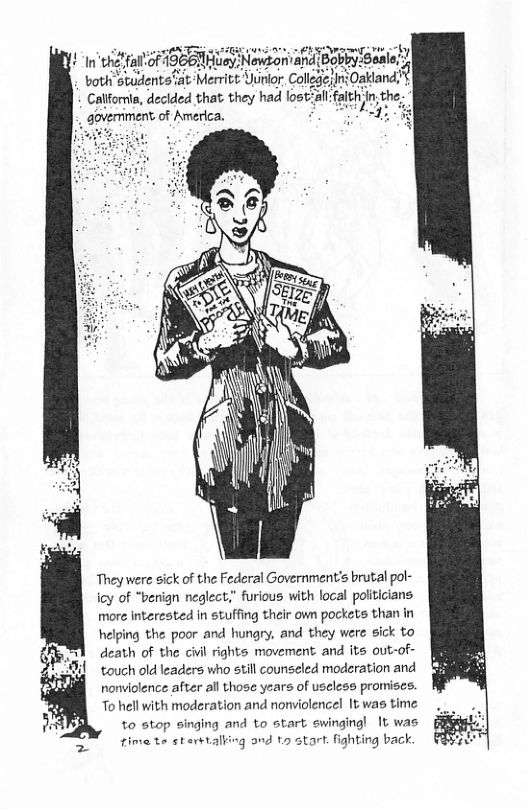
Calforis, declded that they had lostal
govermmen; of America. :
They were sick of the Federal Government's brutal pol-
icy of “benign neglect.” furious with local politicians
more Interested in stuffing their own pockets than in
helping the poor and hungry, and they were sick to
death of the ciil rights movement and its out-of-
touch old leaders who still counseled moderation and
nonviolence after all those years of useless promises.
To hell with moderation and nonviolencel 1t was time
bk %0 stop singing and to o
fima te stervtalking and o
rt ewinging| 1t was
art. fighting back.
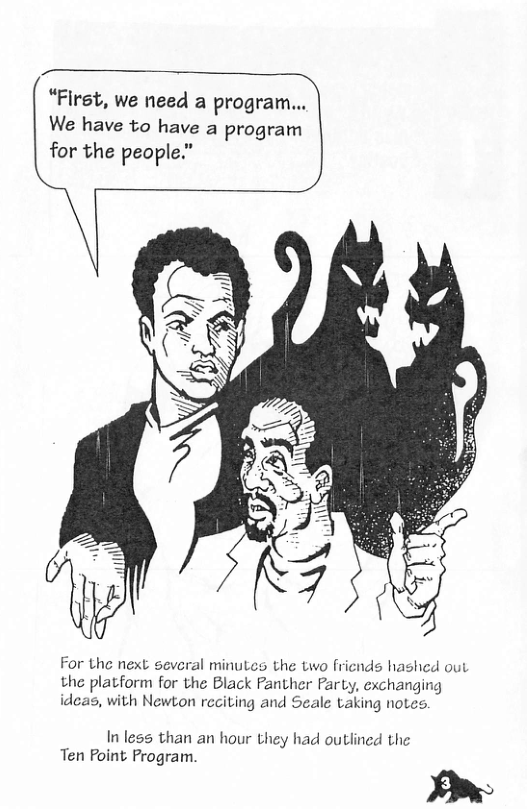
“Firet, we need a program...
We have to have a program
for the people.”
For the next several minutcs the two friends hashed out
the platform for the Black Panther Party, exchanging
idcas, with Newton reciting and Seale taking notes.
In less than an hour they had outlined the
Ten Foint Program
p: 8
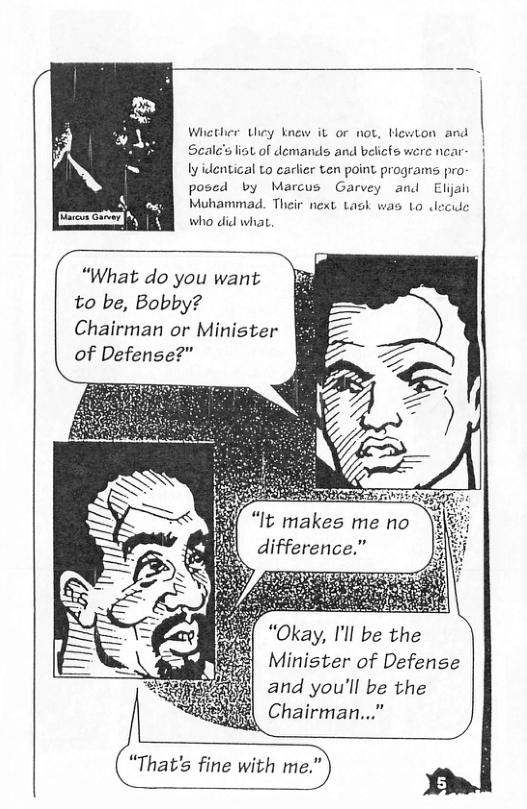
Wither Uhey knew it or not, Hewton and
ly identical to carlier ten point programs pro-
posed by Marcus Garvey and Eljah
Muhammad. Their next tagh was 10 Jlecide
who did what.
“What do you want
to be, Bobby?
Chairman or Minister
of Defense?”
[ “It makes me no I
difference.”
“Okay, I'll be the
Minister of Defense
and you'll be the
Chairman...”
“That’s fine with me.”
Scalc's list of demands and belics were near- |
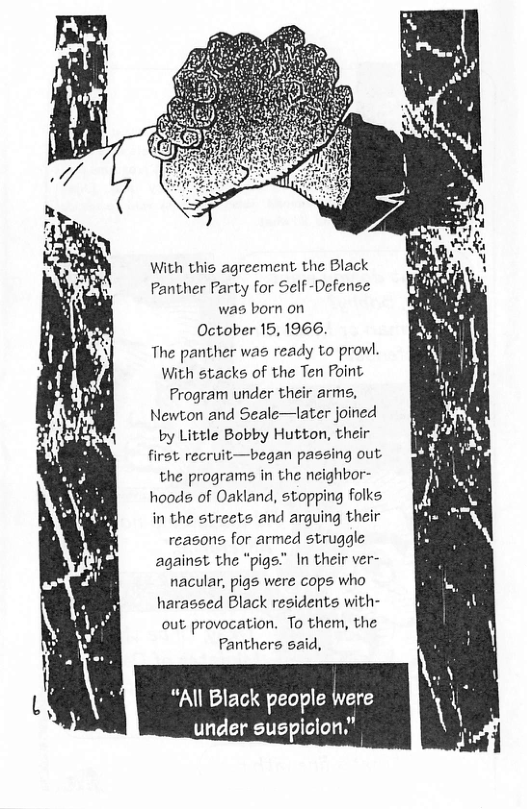
With this agreement the Black
Panther Party for Self -Defense
was born on
October 15, 1966.
The panther was ready to prow.
With stacks of the Ten Foint
Program under their arms,
Newton and Seale—later joined
by Little Bobby Hutton, their
first. recruit—began passing out
the programs in the neighbor-
hoods of Oakland, stopping folks
in the streets and arguing their
reasons for armed struggle
against the “pigs” In their ver-
nacular, pigs were cops who
harassed Black residents with-
out provocation. To them, the
Panthers said,
“All Black people were
under suspiclon.”
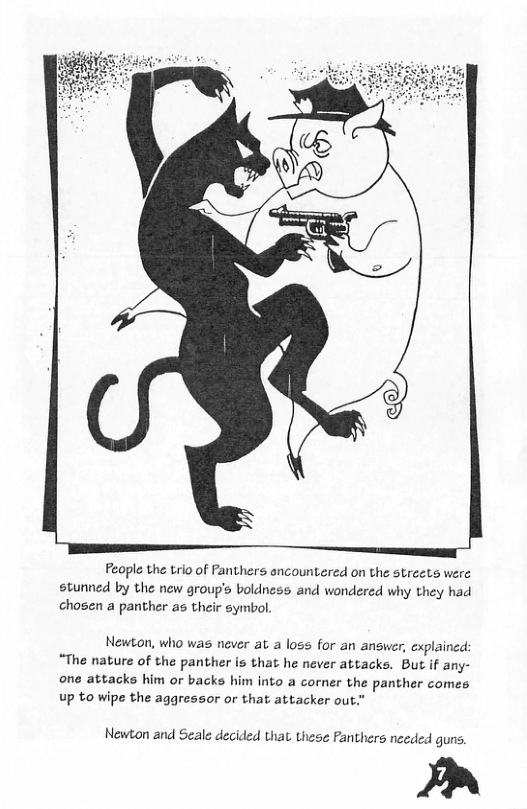
Feople the trio of Panthers sncountered on the streets were
stunned by the new group's boldness and wondered why they had
chosen a panther as their symbol.
Newton, who was never at a loss for an answer, explained:
“The nature of the panther is that he never attacks. But if any-
one attacks him or backs him into a corner the panther comes
up to wipe the aggressor or that attacker out.”
Newton and Scale decided that these Panthers needed guns.
M
| |
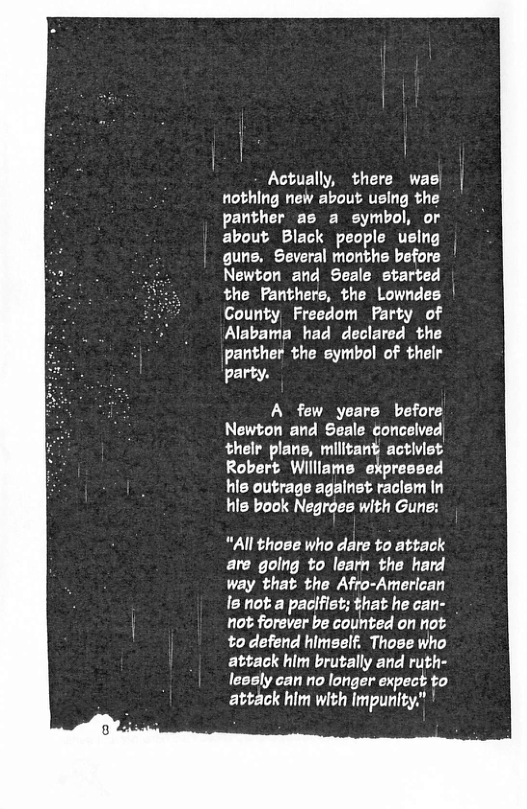
Actually, there was
nothing new about: using the
panther as a symbol, or
about Black people uelng
gune, Several monthe before
Newton and Seale started
the Panthers, the Lowndes
County Freedom Party of
Alabama had declared the
panther the symbol of thelr
party.
A few years before
Newton and Seale concelved|
thelr plans, milltant activist
Robert Willlame expressed
hle outrage agalnst raclem In
hle book Negroes with Gune:
"All those who dare to attack
are going to learn the hard
way that the Afro-Amerlcan
Is ot a pacifist; that he can-
not forever be counted on not
to defend himself. Those who
attack him brutally and ruth-
lessly can ro longer expect to
attack him with Impunity." !
Newton and Seale were Ho
fools: They not only carried guns,
they studied law books. From the law
books they read, Newton and Seale
learned that it was permissible to
carry an unconcealed, unloaded rifle
or a shotgun in California. Because
Newton was on probation, he couldn't
carry a pistol; 50, Seale carried the
pistol, and Newton shouldered an
unloaded M-1 rifle. When they were
accosted by the police, they would
recite the Second Amendment of the
Constitution about the people’s right
to bear arms:
“A well-regulated militia, being nec-
essary to the security of a free
state, the right of the people to
keep and bear arms shall not be
infringed.”
sidents of the
Black community would
see the Fantliers com-
anr of Mao Tse-Tung
famous, quotes, and «
s viile scling bac”
ing and run for cover. / “POWEE \ Lituie red tiont «
The quostion on carn moncy Lo u
aompoty mar [ 11OWS
the guns that th
w’h\ch nobody hkad from the | voung brmlm.g
the nerve to ask— adopted both th
was: o we | DAPPE] Of @
spirit. and letter o
Mao's words an.
became, in their ow
eyes, revolu-
tionarics.
world are those
crazy radicals?”
“Power flows
e barrel of a gun”
gun..."”
fron
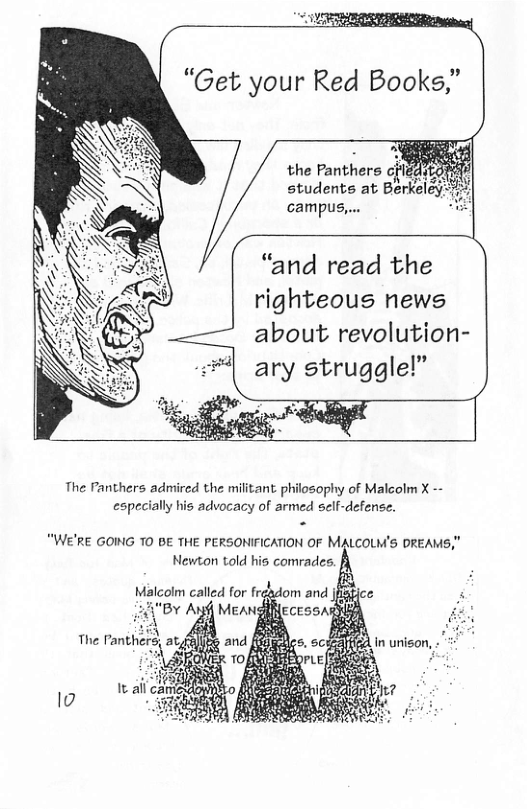
the Panthers ofiéd.
students at Berkel
campus,...
“and read the
righteous news
about revolution-
ary struggle!”
The Panthers admired the militant philosophy of Malcolm X --
especially his advocacy of armed self-defense.
"WE'RE GOING TO BE THE PERSONIFICATION OF MALCOLM'S DREAMS,”
Hewton told his comrades.
Inspired by Malcohm's legacy and funded
by the sales of Mao's Red Book, the
Fanthers expanded their activist agenda
and stepped up their plan to defend the
community.
“We'll protect a mother, protect a broth-
er, and protect the community from
racist cops..”
Seale proclaimed in his autobiography
Seize the Time.
“And in turn we get brothers in the
organization and they will in turn relate
to the Red Book. They will relate to
political, economic, and social equality in
defense of the community."
The activity that really put the Panthers on
the map was “policing the police.”
there were. only 19 Placks
out of GO0 officers on the
Oakland police force, so the
fanthers, 10 say the least, had
their hands full. They were so
balsy that. they actually followed
the Oakland police around,
Whenever they encountered the
yolice harassing or arresting
somebody, Hewton, Seale, and Lil
By, Hubton wowta furglfeon] A
their car and approach the offi-
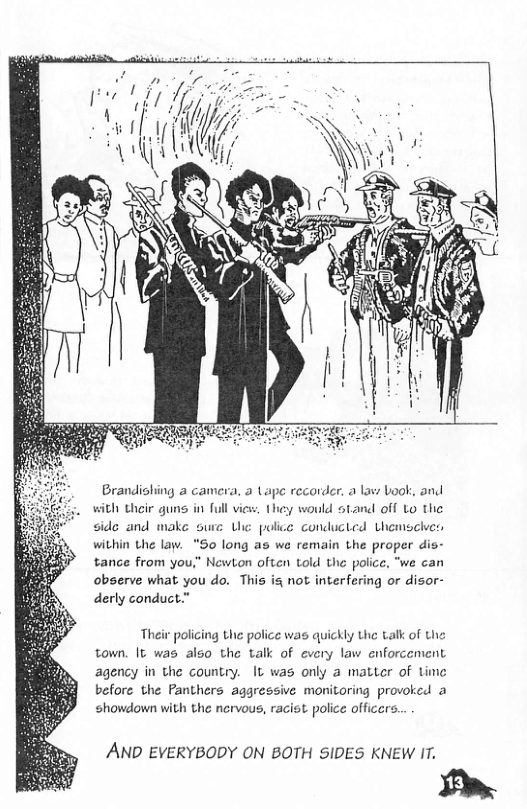
Brandishing a camera, a ape recorder, a lavs Uook, and
with their guns in full view. th
side and make sure Ui police conducted Uhemschves
within Uhe law. “So long as we remain the prope:
tance from you," Newton often told the police,
observe what you do. This is not interfering or disor-
derly conduct.”
would stand off to the
Their policing the police was quickly the Lalk of the
town. It was also the talk of cvory law enforcement
agency in the country. 1t was only a matter of lime
before the Panthers aggressive monitoring provoked a
showdown with the nervous, racist police officers.
AND EVERYBODY ON BOTH SIDES KNEW IT.
P
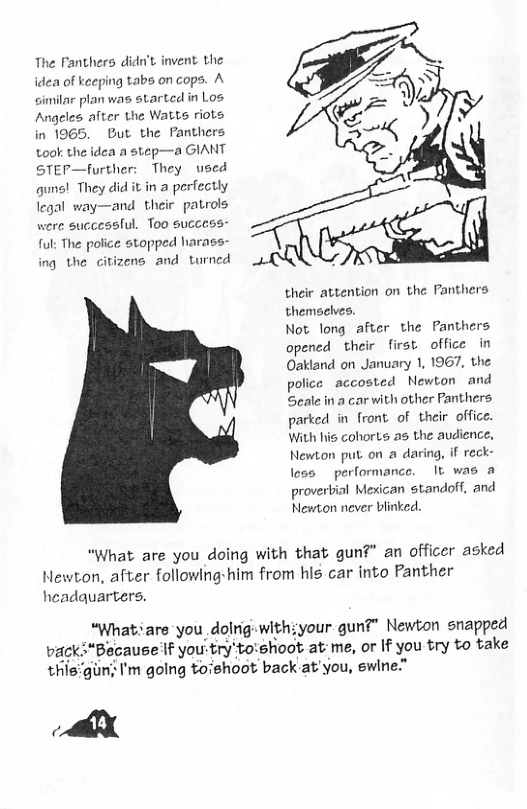
The Fanthers didn't invent. the
idea of keeping tabs on cops. A
similar plan was started in Lo
Angeles after the Watts riots
in 1965. But the Panthers
took the idea a step—a GIANT
STEP—further: They uscd
quns! They did it in a perfectly
legal way—and their patrols
were successful. Too success:
ful: The police stopped harass-
ing the citizens and turncd
their attention on the Panthers
themselves.
Not long after the Fanthers
opened their first office in
Oakland on January 1, 1967, the
police accosted Newton and
Seale ina car with other Panthers
parked in front of their office.
With his cohorts as the audience,
Newton put on a daring, if reck-
less performance. It was a
proverbial Mexican standoff, and
Newton never blinked.
“What are you doing with that gun?" an officer asked
Mewton, after following:him from his car into Panther
headquarters.
“Whatare you_dolrig-with;your gun?" Newton snapped
back:*Because If you try'to:shoot at me, or If you try to take
this‘gin: 'm golng toishoot back at'you, swine.”
X
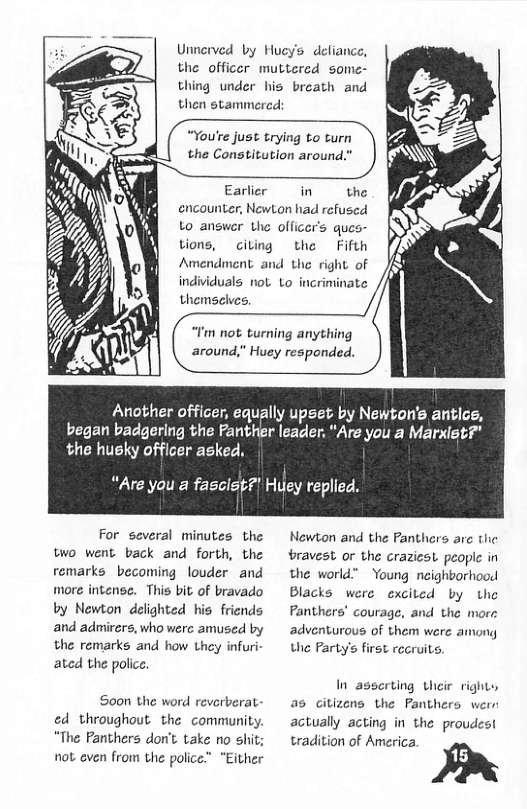
Unnerved by Huey's defiance,
the officer muttered some-
thing under his breath and
then stammered;
“Youre just trying to turn
the Constitution around.”
Earflicr in the
encounter, Newton had refused
to answer the officer’s ques-
tions, citing the Fifth
t and the right. of
luals 1oL Lo incriminate
themsehves.
m not turning anything
around,” Huey responded.
Anather officer, equally upset by Newton's antics,
began badgering the Panther leader. “Are you 2 Marxlgt"
the husky officer asked.
“Are you a fasclgt?! Huey replied.
For several minutes the Newton and the Panthers arc the
o went back and forth, the bravest or the craziest people in
remarks becoming louder and the world” Young ncighborhood
more intenoe. This bit of bravado Blacks were excited by the
by Newton delighted his friends Panthers' courage, and the more
and admirers, who werc amused by adventurous of them were among
the remarks and how they infuri- the Partys first recruits.
ated the police,
In asserting their rights
Soon the word reverberat: as citizens the Panthers werr
ed throughout the community. actually acting in the proudest
“The Panthers don't take o shit;
tradition of America
ot even from the police.” “Either m
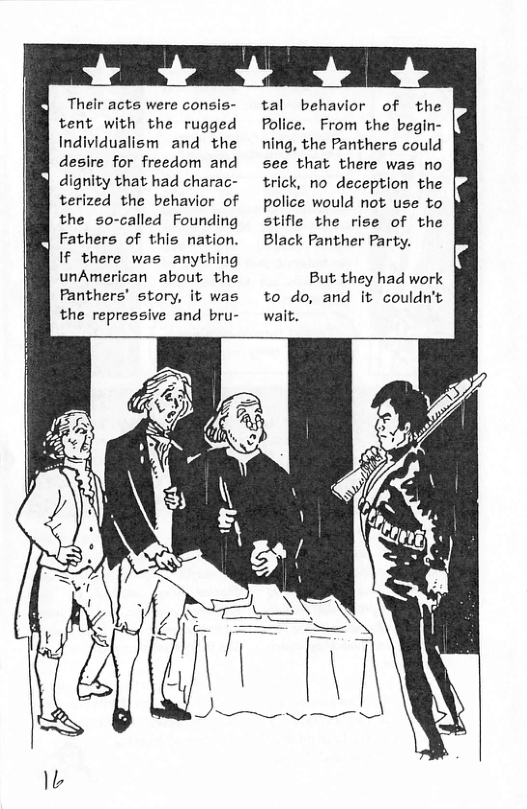
Their acts were consis-
tent with the rugged
individualism and the
desire for freedom and
dignity that had charac-
terized the behavior of
the so-called Founding
Fathers of this nation.
If there was anything
unAmerican about the
Panthers’ story, it was
the repressive and bru-
behavior of the
From the begin-
ning, the Panthers could
see that there was no
trick, no deception the
police would not use to
stifle the rise of the
Black Panther Party.
But they had work
to do, and it couldn’t
wait.
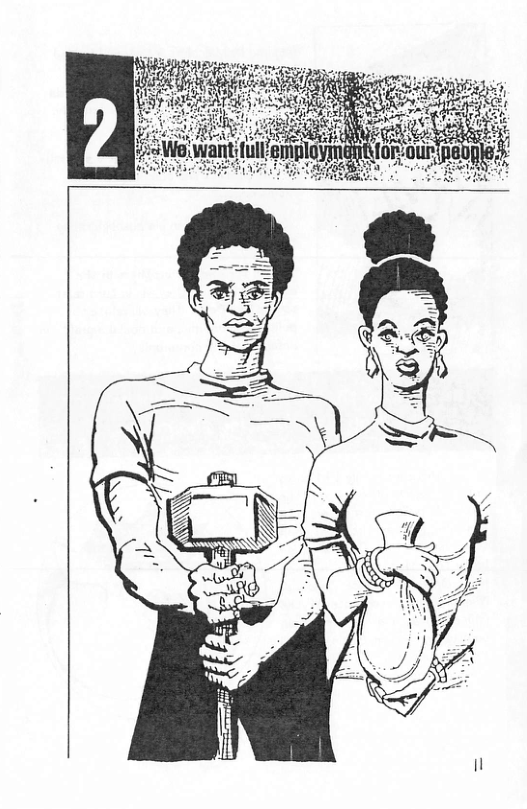
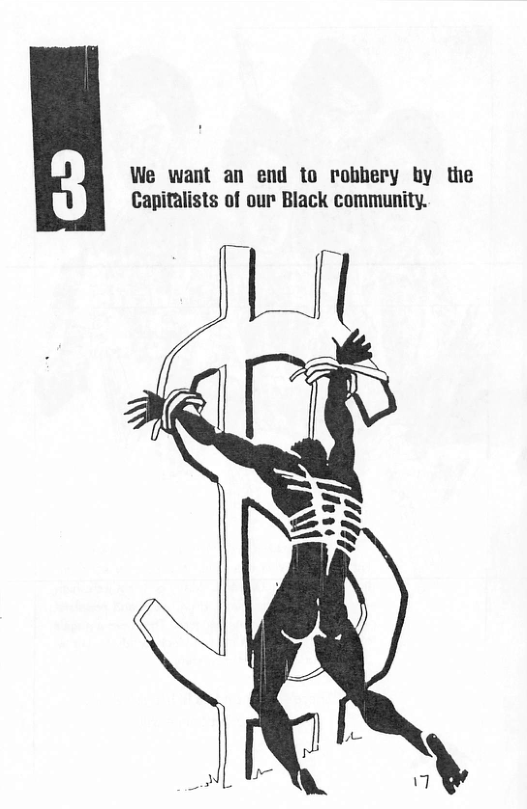
We want an end to robbery by the
Capitalists of our Black community.
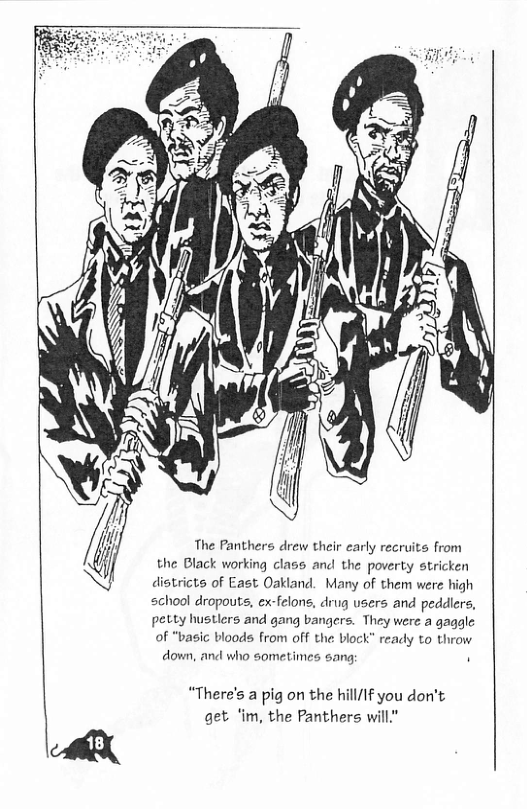
The Panthers drew
ir carly recruits from
the Black working class and the poverty stricken
districts of East Oall ' of them were high
school dropouts, ex-felons, druig users and peddiers,
petty hustlers and gang bangers. They were a gaggle
of “basic bloods from off the block” ready to throw
down, and who sometim
“There's a pig on the hill/If you don't
get ‘im, the Panthers will"
ployment rate was almosi tuice. ¥
national average. Complemicnty
this ragtag crew were a number of
Panthers who attended college, el
down full-time jobs, or were mercl
impressionable youth eager for
kind of action.
Attraction to the Panthers
was not limited, however, to just
teenagers: a gaggle of older
men and women, Black and
white, fell under the spel of the
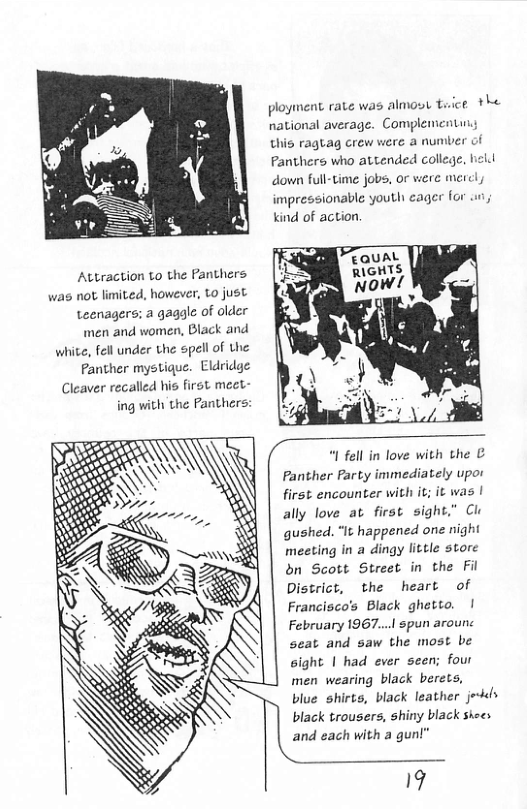
Panther mystique. Eldridge
Cleaver recalled his first meet-
ing with the Panthers:
“I fell in love with the €
Panther Party immediately upor
first encounter with it; it was |
ally love at first sight.” Cl
gushed. “It happened one night
meeting in a dingy little store
n Scott Street in the Fil
District, the heart of
Francisco's Black ghetto. |
February 1967... spun arounc
seat and saw the most be
sight | had ever seen; four
men wearing black berets,
blue shirts, black leather jo-ids
black trousers, shiny black sices
and each with a gun!”
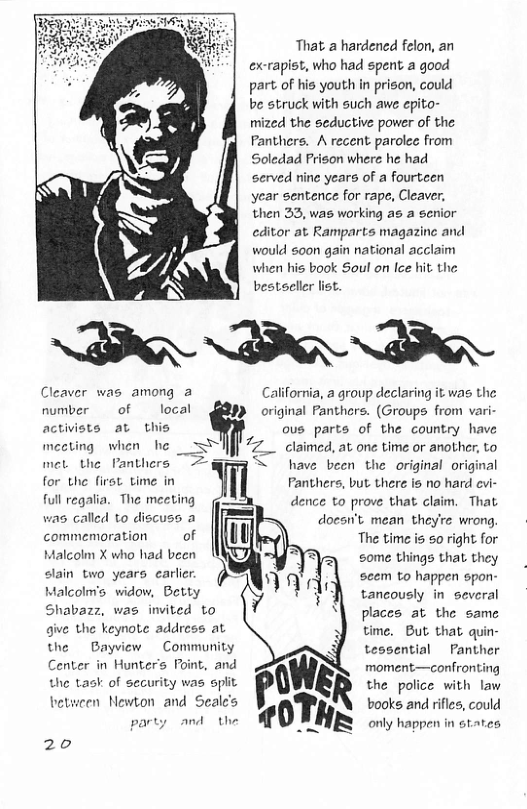
That a hardencd felon, an
ex-rapist, who had spent a good
part of his youth in prison, could
be struck with such awe pito-
mized the seductive power of the
Panthers. A recent parolec from
Soledad Prison where he had
served nine years of a fourtcen
year sentence for rape, Cleaver,
then 33, was working as a scnior
cditor at. Ramparts magazine and
would soon gain national acclaim
when his book Soul on Ice hit the
Cleaver was among a Califorria, a group declaring it was the
number of local ) original Panthers. (Groups from vari-
activists at this ous parts of the country have
mecting when he SN 7Z_ claimed, at one time or another, to
met the Panthers 2 have been the original original
no hard evi-
full regalia. The meeting dence to prove that claim. That
was called to discuss a
commemoration of
Malcolm X who had been
slain two years carlier
Malcolm's widow, Betty
Shabazz, was invited to
gie the keynote address at
the Bayview Community
Center in Hunter's Point, and w
oT" books and rifles, could
between Newton and Seale’s
doesn't. mean theyre wrong.
The time is 50 right.for
some things that they
seem to happen spon-
tancously in several
places at the same
time. But that quin-
tessential Panther
moment—confronting
20
ighabazz airlved for thememorfaizafie
washoscorted by the members’ of the i
Panther groups and everything went off with
out a hitch untll Newton discovered that
‘the Panthers from Northern Callfornia were
carrylng unloaded weapons. Protecting
Malcolm's widow ~ with unloaded
weapone—they may as well have been
using water plstols| Newton was furious.
He told the Northerners they had three
cholcee: Joln Newton's Panthers, change
thelr name, or disband. They found none
of the options o their liking. Newton and
his Panthers made it plain that they were
not Jiving. The group changed its name.
By the spring of
1967, the Panther
party had increased
its numbers, pub-
lished its first.
mimeographed
newsletter, and
gained wider recog-
nition for ite
brazen contempt
for the police, who
by now were always
referred to as the
"pigs."
IWHY WAS DENLIL
‘DOWELL K|L|_ED
T
[Brge
et
[P
)21 G
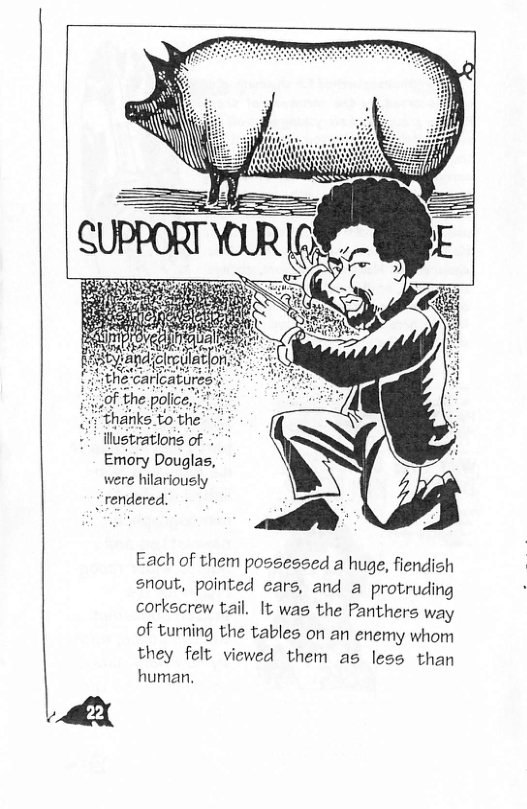
Emory Douglas,
were hilariously
“rendered. ‘
Each of them possessed a huge, fiendish
shout, pointed ears, and a protruding
corkscrew tail. It was the Panthers way
of turning the tables on an enemy whom
they felt viewed them as less than
human
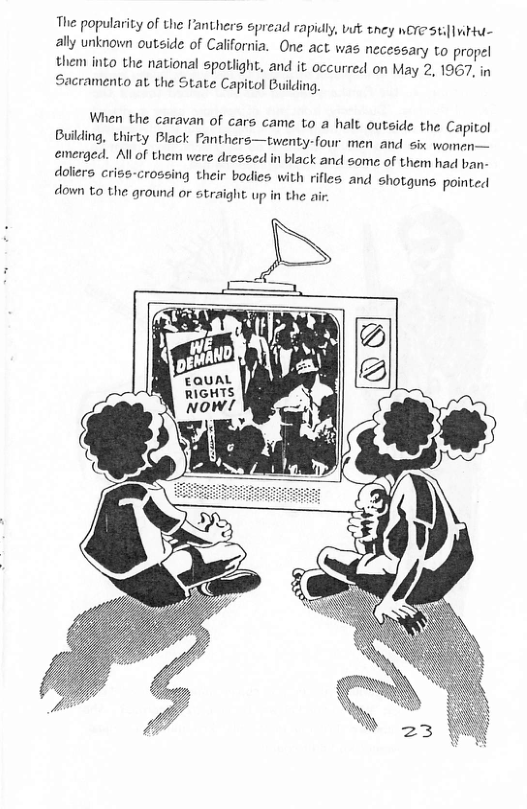
The popularity of the Vanthers spread rapidly, it they nore stillvibu-
aly unknown outside of Califoria. One act was necessary to propel
them into the national spotlight, and it occurred on May 2, 1967, in
Sacramento at. the State Capitol Building.
When the caravan of cars came to a halt outside the Capitol
Cuilding, thirty Black Panthers—twenty-four men and s woman—
emerged. Allof them were dressed in black and some of them had ban-
doliers criss-crossing their bodies with rifles and shotguns pointed
down £o the ground or straight up in the air.
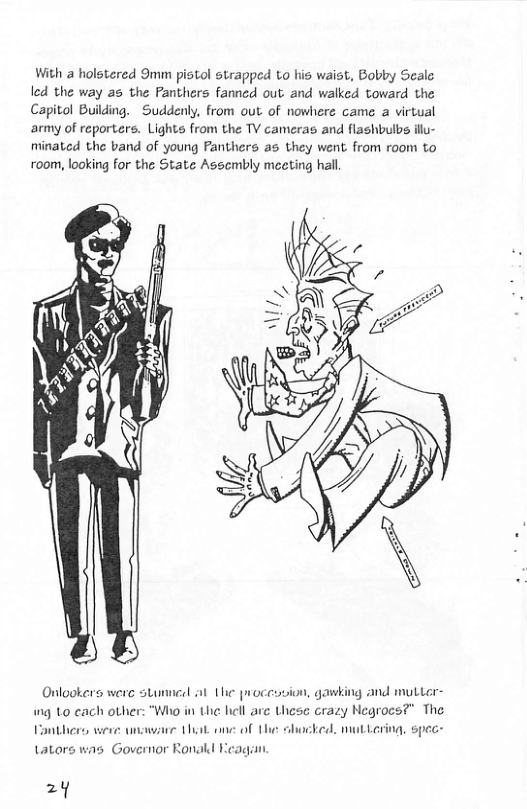
With a holstered 9mm pistol strapped to his waist, Bobby Scale
led the way as the Panthers fanned out and walked toward the
Capitol Building. Suddenly, from out of nowhere came a virtual
army of reporters. Lights from the TV cameras and flashbulbs ilu-
minated the band of young Panthers as they went from room to
room, looking for the State Asscmbly meeting hall
Onlookers werc stumicd it Uhe procession, gawking and mutter-
ing Lo cach other: "Who in the hell are these crazy Negrocs?” The
hocked. muLering, spec-
Fanthers weve wnawane that one of e
tators was Governor Ronald Fcagin,
2y
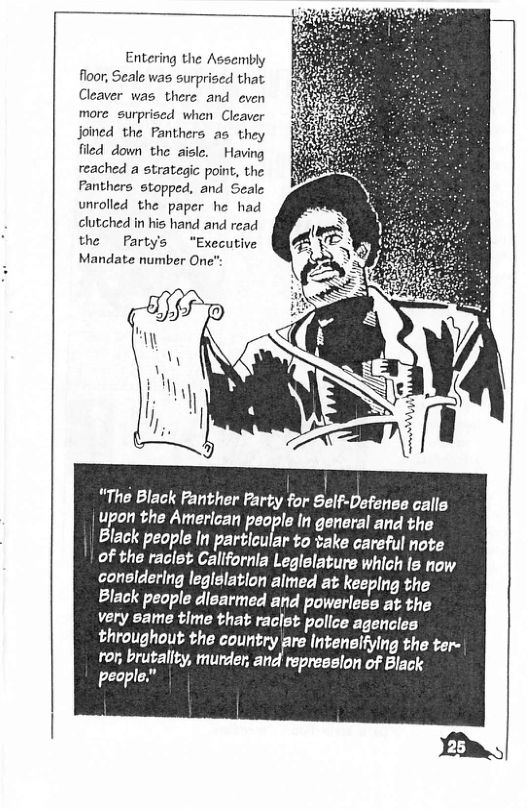
Entering the Assembly
floor, Seale was surpriscd that.
Cleaver was there and even
more surprised when Cleaver
Joined the Panthers as they
filed down the aisle. Having
reached a strategic point, the
Panthers stopped. and Seale
unrolled the paper he had
clutched in his hand and read
the Fartys “Executive
Mandate number One"
et
“The Black Fanther Party for Self-Defenee calls
| upon the American paaf!a In general and the
a
Black people In particular to take careful note
1 of the raclet Calfornla Leglelature which (s how
coneldering leglelation almed at keeplng the
Black people diearmed and powerless at the
very same time that raclet: police agencles
throughout the country ,,fm Intenelfying the ter-
ror, brutallty, murder, and represslon of Black
people.”
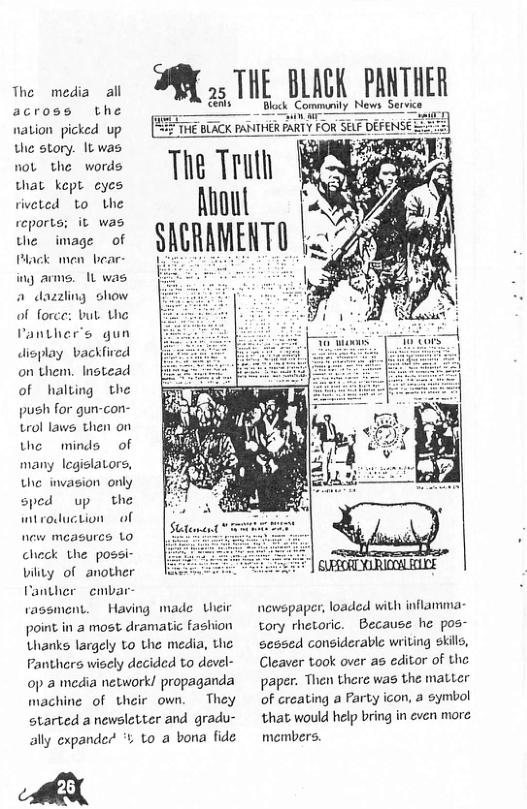
The media al
across the
nation picked up
the story. It was
ot the words
that kept cyes
riveted to the
reports; it was
the image of
Plack men bear-
ing arms. 1L was
A dazzling show
of force: bul. the
Panther's gun
display backfired
on them. Instead
of halting the
push for gun-con-
trol laws then on
the minds of
many legislators,
the invasion only
sped up the
mtroduction of
new measures 10
check Uhe possi-
vility of another
Fanther cmbar-
rassment. Having made Ueir
point in a most dramatic fashion
hanks largely to the media, the
Fanthers wisely decided to devel-
op a media network! propaganda
machine of their own. They
started anewsletter and gradu-
ally expanded % to a bona fide
X
. A THE BLAcK FATHER
" Block
Communiy New Servks
Te T B
Aot
newspaper, loaded with inflamma-
tory rhetoric. Because he pos-
seosed considerable writing skills,
Cleaver took over as editor of the
paper. Then there was the matter
of creating a Party icon, a symbol
that would help bring in even more
members.
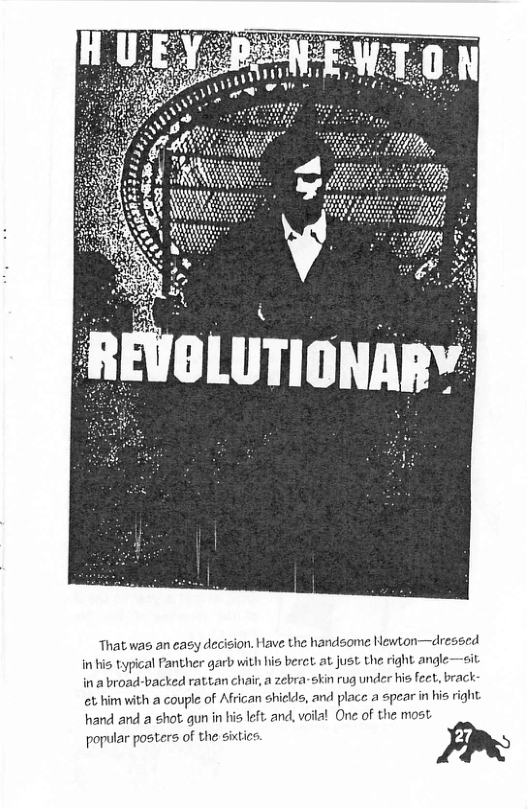
That was an casy decision. Have the handsome Newton—dressed
in his typical Panther garb with his berct. at just. the right angle—sit
i broad-backed rattan chair,a zebra-skin rug under his feet, brack
et im with a couple of African shiclds, and place a spear i his right.
hand and a shot qun in his left. and, voila! One of the most.
popular posters of the sixtics,
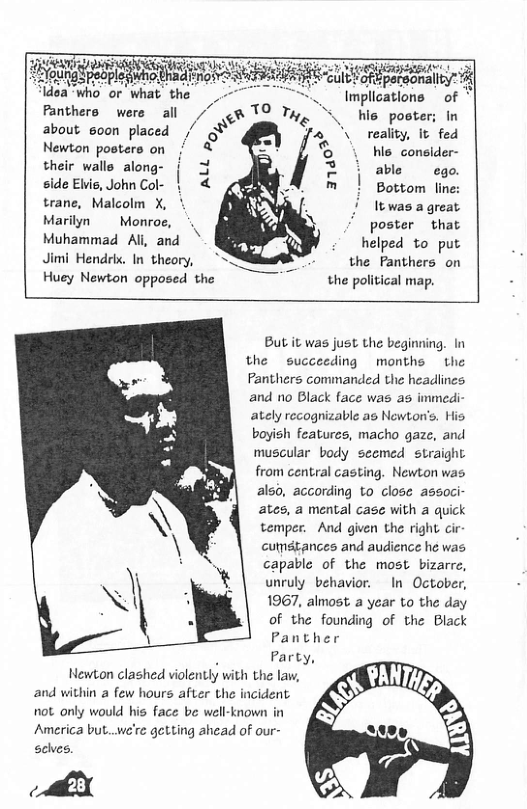
Implications of
his poster; In
about soon placed \ reality, it fed
Newton posters on
/ his consider-
their walle along- { able ego.
e Ehi, John Col- | Bottom line:
trane, Malcolm X, Itwas a great
Marilyn Monroe,
Muhammad All, and
Jimi Hendrlx. In theory,
Huey Newton opposed the
poster that
helped to put
the Panthers on
the political map.
But it was just the beginning. In
the succeeding months the
Panthers commanded the headiines
and no Black face was as immedi-
ately recognizable as Newton's, His
boyish features, macho gaze, and
muscular body scemed straight
from central casting. Newton was
als, according to close associ-
ates, a mental case with a quick
temper. And given the right cir
cutndtances and audience he was
capable of the most bizarre,
unruly behavior. In October,
1967, almost. a year to the day
of the founding of the Black
Panther
i Party,
Newton clashed violently with the law,
and within a few hours after the incident
not only would his face be well-nown in
America but...we're getting ahead of our-
sehves.
2 ¢
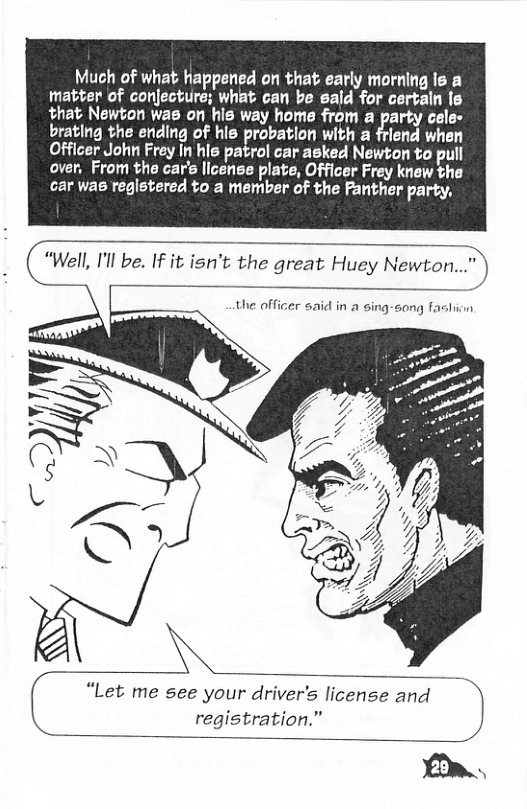
Much of what happened on that early morning le a
matter of conjecture; what can be eald for certain ls
that Newton wae on his way home from a party cele-
bratlng the ending of hle probatlon with a friend when
Officer John Frey In hie patrol car asked Newton to pull
over, From the car’ license plate, Officer Frey knew the
car was reglstered to a member of the Panther party,
Cwer/, Il be. If it isn't the great Huey Newton.
the officer said in a sing-song fastiin
“Let me see your driver's license and W
k registration.”
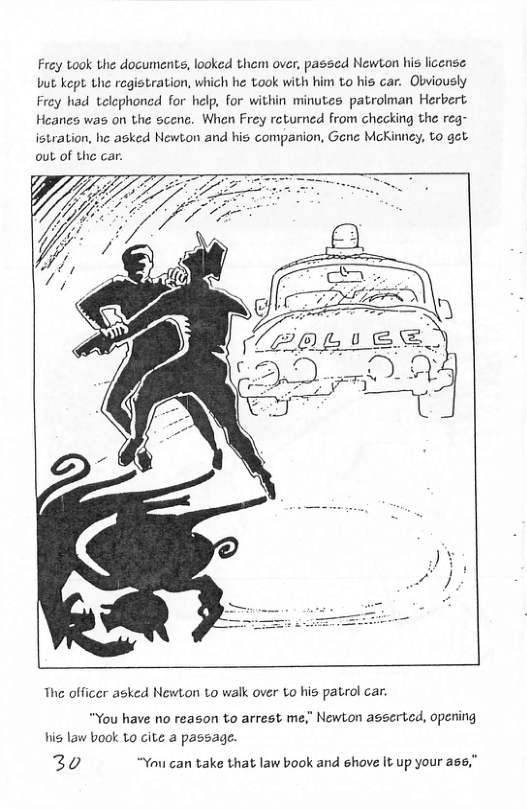
Frey took the documents, looked them over, passcd Newton his license.
but kept the registration, which he took with him to his car. Obviously
Frey had telephoned for help, for within minutes patrolman Herbert
Heanes was on the scene. When Frey returned from checking the reg-
istration, he asked Newton and his companion, Gene McKinney, to got
out of the car.
The officer asked Newton to walk over Lo his patrol car.
“You have no reason to arrest me,” Newton asscrted, opering
his law book 10 cite a passage.
30 “You can take that law book and shove It up your ass,”
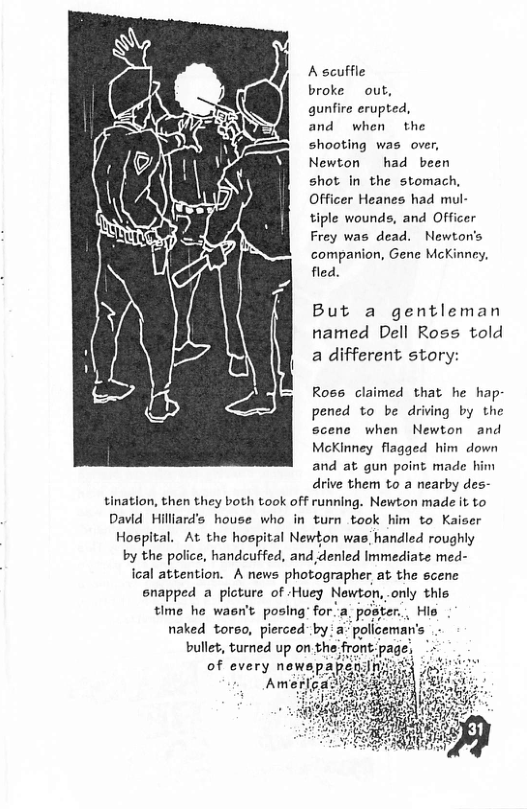
A scuffle
broke out,
qunfire erupted,
and when the
shooting was over,
Newton had been
shot in the stomach,
Officer Heanes had mul-
tiple wounds, and Officer
Frey was dead. Newton's
companion, Gene McKinney,
fled.
But a gentleman
named Dell Ross told
a different story:
Ross claimed that he hap
pened to be driving by the
scene when Newton and
McKinney flagged him down
and at gun point made him
drive them to a nearby des-
tination, then they both took off running. Newton made it to
David Hilliard's house who in turn took him to Kaiser
Hospital. At the hospital Newton was, handled roughly
by the police, handcuffed, and denled Immediate med-
fcal attention. A news photographer. at the scene
enapped a ploture of Huey Newton, .only this
time he waen't posing’ for "a, poster. , Hio
naked torso, plerced by:a policeman's
bullet, turned up on the front page; '~
of every nowspape o
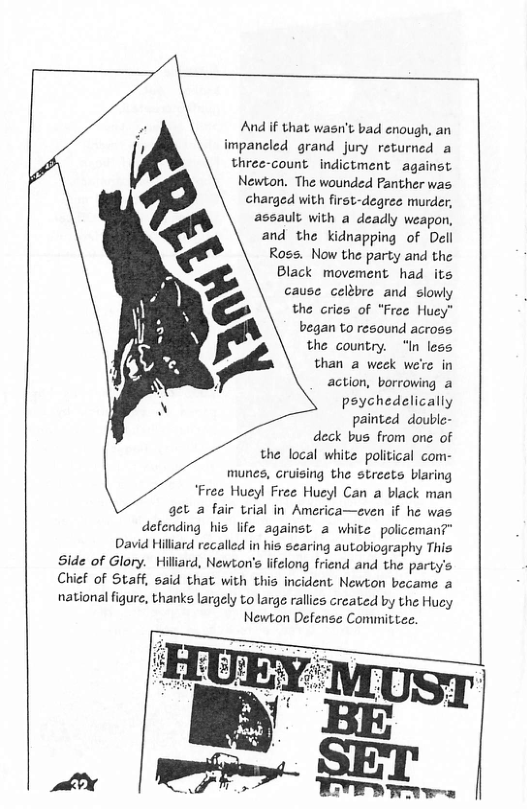
And if that wasn't bad enough, an
impancled grand Jury returned a
three-count indictment against
Newton. The wounded Panther was
charged with first-degree murder,
assault with a deadly weapon,
and the kidnapping of Dell
Ross. Now the party and the
Black movement had its
cause celtbre and slowly
the cries of "Frec Huey"
began to resound across
the country. “In less
than a week we'e in
action, borrowing a
psychedelically
painted double-
deck bus from one of
the local white political com-
munes, Gruising the streets blaring
‘Free Hueyl Free Hueyl Can a black man
get a fair trial in America—even if he was
defending his life against a white policeman?”
David Hilliard recalled in his searing autobiography This
Side of Glory. Hiliard, Newton's lifelong friend and the party's
Chicf of Staff, said that with this incident Newton became a
national figure, thanks largely to large rallics created by the Hucy
Newton Defense Committec.
The first rallies and
marches vere held at.
the courthouse with
brothers and sisters
chanting: “Free Huey.
Free Huey, Free Huey,
or the sky's the limit!
Soon it was a kind of
shared mantra that.
reverberated beyond the
radical community, unit
ing folks around the
world who were
ested in social
and poiical freedom.
HAPPY BIRTHDAY
“In February we host the
grand birthday party
(Mewton was born
February 17, 1942]
attended by H. Rap
Brown and Stokely
Carmichael” Hiliard con-
tinued. “Huey and the
Black Panther Party are
becoming known nation-
wide. Every day people
call headquarters want-
ing to give money, start
chapters. The second life
“of the Party has bequn.”
Fund Raising
HUEY
Birthday
Benefit for
|
|
|
|
| N
‘\ HUEY P.
i NEWTON
I
|
|
|
|
|
Sonday, Feb. 16, Berheley Dbfimmy Thealn
oo 1 .00
Wi
i
P
e
oy s g
e
v
hss N
Indceid. the moncy flowed in from all over Lie place as the Fanthers spon
sorcd lorums, workshops, and rallics on campuses, at churches and conr
iunity organizations. Contributions came in from concerned individuals
and support. groups, including lorerunncrs of Lhe White Panthers, Grey
antiirs, and Uhe Young Lords. There was even a delegation calling thepn-
Honkies for Huey. I Newton was to have the proper representation
during the upcoming trial, then buckets of donations were needed, the
Panthers preached,
selves
A decisive coalition was formed between the Fanthers and the Feace and
mostly white independent political party—and fron|
this alliance additional money was raised in order Lo secure the services|
of attorney Charles Garry. Still another alliance was forged between the|
Vanthers and leaders of the Student Nonviolent. Coordinating Commit.e]
(SNCC). Morc than $10,000 was raised at. a rally in Oakland tha
January (caturing Carniichacl, James Forman, and . Rap Brown. T
money lasted longer than the aliance,
i g
Ficedom Par
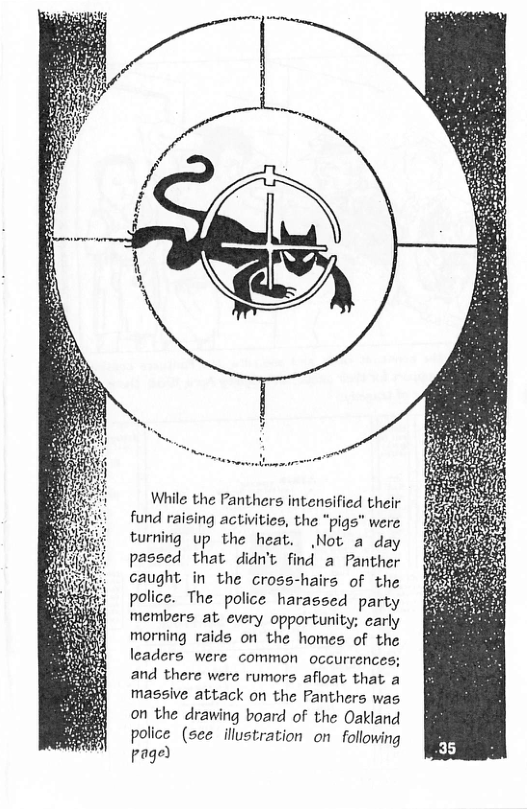
While the Panthers intensifi
fund raising activities, the “pigs” were
turning up the heat. Not a day
passed that didn't find a Panther
caught in the cross-hairs of the
police. The police harassed party
members at every opportunity; carly
morning raids on the homes of the
leaders were common occurrences;
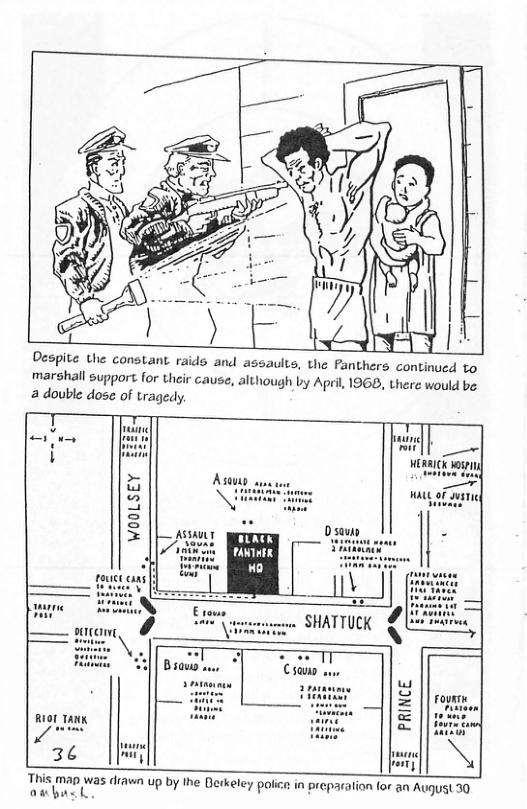
and there were rumors afloat that a
massive attack on the Panthers was
on the drawing board of the Oakland
police (see illustration on following
page)
Despite the constant raids and assaults, the Fanthers continued to
marshall support for their cause, although by April, 1968, there would bo
a double dose of tragedy.
T
hun
i
i
e
3¢ | N\
1n-c\:wanlr«as e up by the Berkeley police in preparation for an August 30
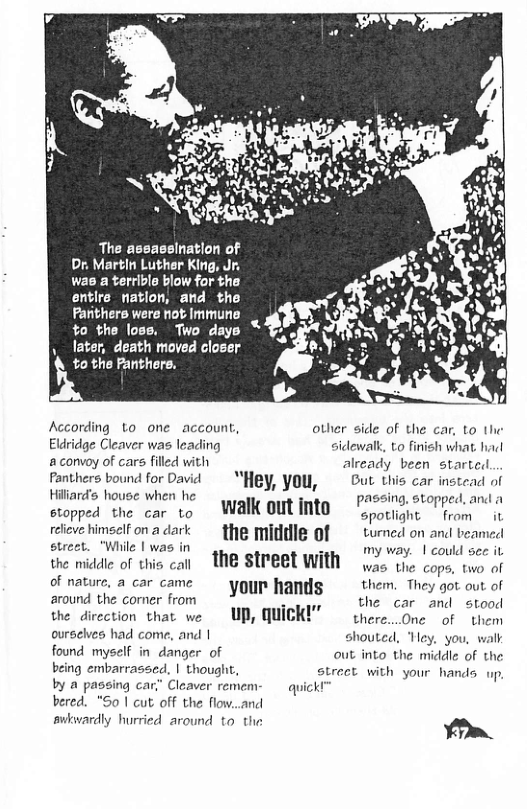
The aseasslnatlon of
Dr. Martin Luther King, Jr.
was a terrlvle blow for the
entlre natlon, and the
Parithers were nob Immuna
to the lose. Two days
later, death moved closer
to the Panthers.
According to one account,
Eldridge Cleaver was leading
a convoy of cars filled with
oL
her side of the car, to the
sidewalk, to finish what. ha
already been started
Panthers bound for David “Hey, you, But this car instead of
Hiliard's house when he passing, stopped, and a
stopped the car to WaIK OUtinto TR EEOrEe Al
reievehimselfonadark e middle 0f tomed on and beamed
street. "Wl | was in S myway. | could sec it
the middle of thio cat TN SIPEELWIth 2" (o0l 0 oy
of naure, a car came youp hang them. They got out of
around the corner from g the car and stood
the direction that we U, (UICKY there...One of them
ourselves had come, and |
found myself in danger of
being embarrassed. | thought,
by a passing car.” Cleaver remem-
bered. “So | cut off the flow..and
awkwardly hurried around to the
quick!”™
shouted, ey, you, walk
out into the middle of the
strect with your hands up,
b2 N
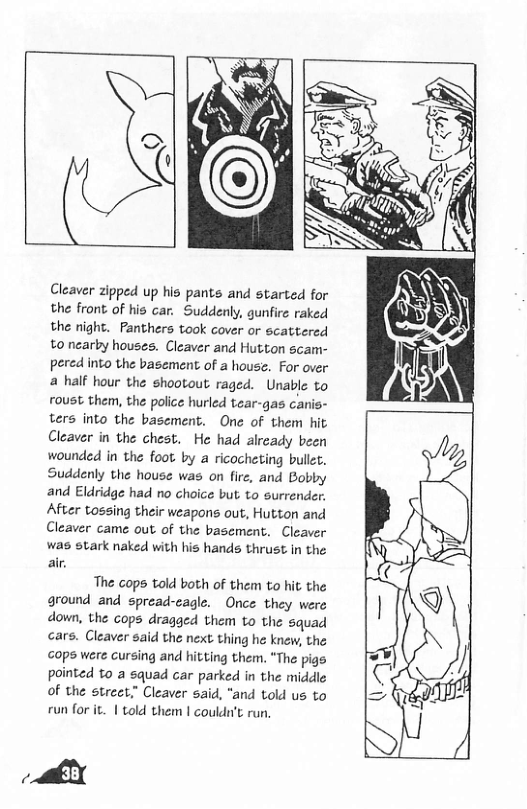
Cleaver zipped up his pants and started for
the front of his car. Suddenly, gunfire raked
the night. Panthers took cover or scattered
to nearby houses. Cleaver and Hutton scam-
pered into the basement of a house. For over
a half hour the shootout raged. Unable to
roust them, the police hurled tear-gas canis-
ters into the basement. One of them hit
Cleaver in the chest. He had already been
wounded in the foot. by a ricocheting bulet.
Suddenly the house was on fire, and Bobby
and Eldridge had o choice but to surrender.
After tossing their weapons out, Hutton and
Cleaver came out of the basement. Cleaver
was stark naked with his hands thrust in the
air.
The Gops told both of them to hit. the
ground and spread-cagle. Once they were
down, the Gops dragged them to the squad
cars. Cleaver said the next thing he knew, the
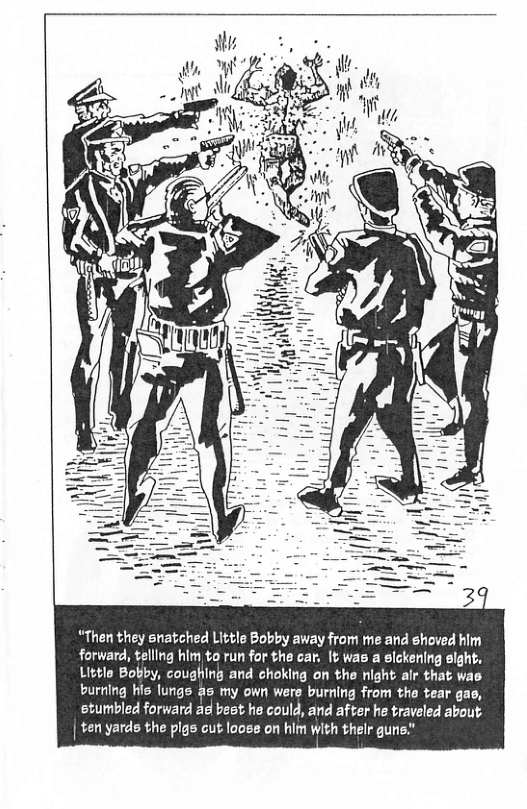
Gops were cursing and hitting them. "The pigs
pointed to a squad car parked in the middle
of the street,” Cleaver said, "and told us to
run for it. | told them | couldn't run.
P 2 ¢
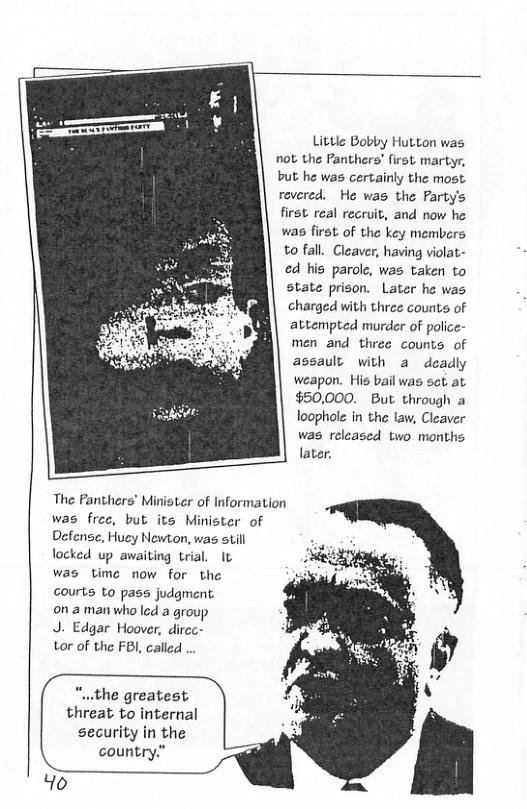
but he was certainly the most
The Panthers’ Minister of Information
was frce, but its Minister of
Defense, Huey Newton, was still
locked up awaiting trial. It
was time now for the
courts to pass judgment
ona man who led a group
J. Edgar Hoover, dircc-
tor of the FB, called ...
the greatest
threat to internal
security in the
country."
Little Bobby Hutton was
not the Panthers’ first martyr,
revered. He was the Party's
first. real recruit, and now he
was first of the key members
to fall. Cleaver, having violat-
ed his parole, was taken to
state prison. Later he was
charged with three counts of
attempted murder of police-
men and three counts of
assault with a deadly
weapon. His bail was sct at
$50,000. But through a
loophole in the law, Cleaver
was released two months
later.
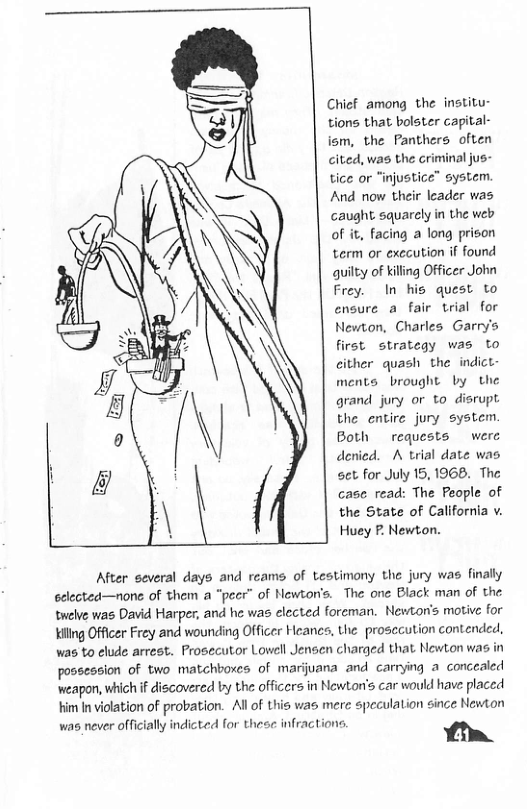
Chicf among the institu-
tions that bolster capital-
ism, the Panthers often
cited, was the criminal jus-
tice or “injustice” system.
And now their leader was
caught squarely in the web
of it, facing a long prison
term or exccution if found
guilty of killing Officer John
Frey. In his quest to
ensure a fair trial for
Newton, Charles Garry's
first strategy was to
cither quash the indict-
ments brought by the
grand jury or to disrupt
the entire jury system.
Both requests were
denied. A trial date was
set for July 15,1968, The
case read: The People of
the State of California v.
Huey P. Newton.
After several days and reams of testimony the jury was finally
selected—none of them a “peer” of Hewtoris, The one Black man of the.
twelve was David Harper, and he was elected foreman. Newton's motive for
Hiling Officer Frey and wounding Officer Heanes, the prosccution contended,
was 0 elude arrest. Prosecutor Lowell Jensen charged that. Newton was in
possession of two matchborcs of mariuana and carrying a concealed
‘weapon, which f discovered by the officers in Newtoris car would have placed
him In violation of probation. All of this was mere speculation since Newton
was never officially indicted for theec infractione. £t
"y
"HUEY"
"HUEY"
"HUEY"
"HUEY"
"HUEY"
"HUEY"
"HUEY"
"HUEY"
P2 ¢
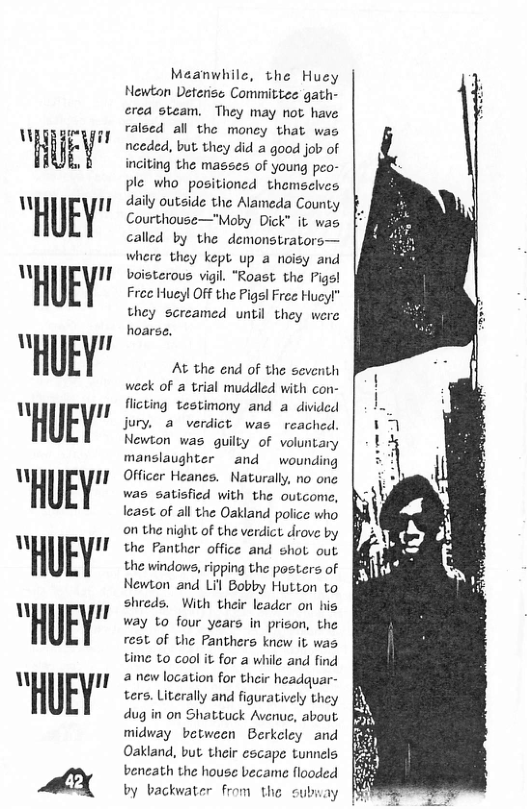
Meanwhile, the Huey
Newton Deterise Committee gath-
crea stcam. They may not have
ralsed all the moncy that was
needed, but they did a good job of
inciting the masses of young peo-
ple who positioned themselves
daily outside the Alameda County
Courthouse—"Moby Dick” it was
called by the demonstrators—
where they kept up a noisy and
boisterous vigil. "Roast the Pigs!
Frec Hueyl OFf the Pigs! Free Hueyl"
they screamed until they were
hoarse,
At the end of the seventh
week of a trial muddied with con-
flicting testimony and a divided
jury. a verdict was reached.
Newton was guilty of voluntary
manslaughter and wounding
Officer Heanes. Naturally, no one
was satisfied with the outcome,
least of all the Oakland police who
on the night of the verdict drove by
the Panther office and shot out
the windows, ripping the posters of
Newton and Lil Bobby Hutton to
shreds. With their leader on his
way to four years in prison, the
rest of the Panthers know it was
time to ool it for a while and find
a new location for their headquar-
ters. Literally and figuratively they
dug in on Shattuck Avenuc, about
midway between Berkeley and
Oakland, but their cscape tunnels
bencath the house became flooded
by backwater from the sub
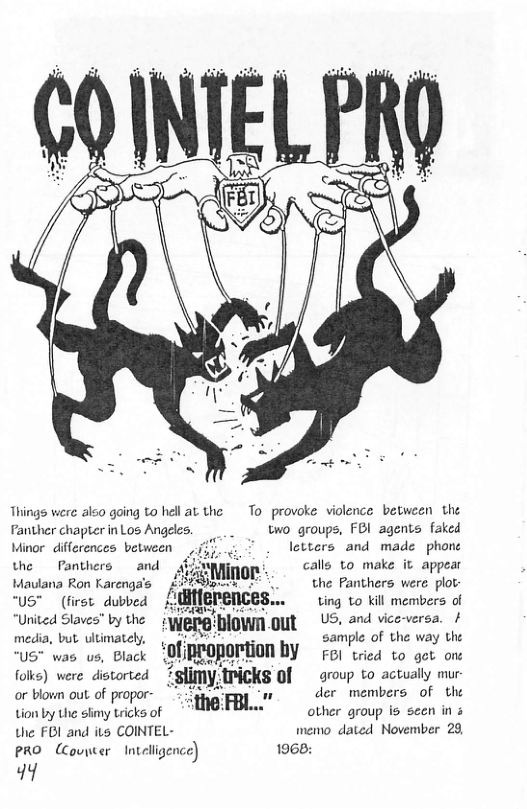
Things were also going to hell at the To provoke violence between the
Fanther chapterinLos Angeles. ___ two groups, FBI agents faked
Minor differences between letters and made phone
the Panthers and calls to make it appear
Mavlana Ron Karenga's the Panthers were. plot:
“US" (first dubbed ting 1o kil members of
“United Slaves” by the US, and vice~versa.
media, but ultimately, sample of the way the
"US" was us, Black FBI tried to get on
folks) were distorted *glimy tPiCk8 Of group to actually mur
or blovn out of propor- mem n der members of the
tion by the shimy tricks of other group is seen in s
the FBI and its COINTEL- memo dated November 29,
RO (Councer Intellig 1968:
49
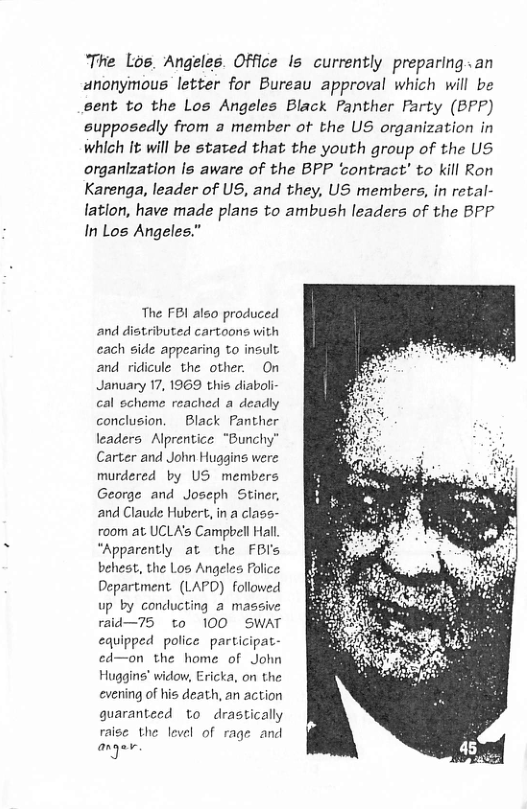
The Los. Angeles. Office Is currently preparing.an
anonymous letter for Bureau approval which will be
sent to the Los Angeles Black Panther Farty (BFF)
supposedly from a member ot the US organization in
which It will be stated that the youth group of the US
organization is aware of the BPP contract’ to kill Ron
Karenga, leader of US, and they, US members, in retal-
latlon, have made plans to ambush leaders of the BPP
In Los Angeles.”
The FBI also produced
and distributed cartoons with
each side appearing to insult.
and ridicule the other. On
January 17, 1969 this diaboli-
cal scheme reached a deadly
conclusion. Black Panther
leaders Alprentice “Bunchy”
Carter and John Huggins were
murdered by US members
George and Joseph Stiner,
and Claude Hubert, in a class-
room at UCLA's Campbell Hall
“Apparently at the FDIs
behest, the Los Angeles Police
Department. (LAPD) followed
up by conducting a massive
r@id—75 to 100 SWAT
equipped police. participat-
ed—on the home of John
Huggins' widow, Ericka, on the
evening of his death, an action
guaranteed to drastically
raioe the level of rage and
anger
"If my enemies, your enemies prove stronger [than
us,] at least | want them to know that they made one
righteous African man extremely angry."
George Jackson
This pamphlet is the first of three that go
with this series. All three cost $4.00. For
the finest in revolutionary zines, wiite to
So. Chicago ABC Zine Distro
PO Box721
Homewood, IL 60430